





Beyond the Prompt: Why Human Business Analysts are More Important in the AI Era.
The narrative surrounding Artificial Intelligence in 2026 often feels like a countdown clock for white-collar professionals. We see AI drafting code, generating marketing copy, and even performing complex data modeling in seconds. For a student entering a Business Analyst Internship, it is natural to feel a sense of existential dread. If a Large Language Model can take a prompt and spit out a set of user stories, what is left for the human analyst to do?
However, three months into my own internship, I have realized that the "AI Revolution" hasn't made the Business Analyst (BA) obsolete; it has actually raised the stakes for what a human analyst must bring to the table. While AI is an incredible "Execution Engine," it lacks the three fundamental pillars of successful business transformation: Context, Empathy, and Ethical Judgment.
In the AI era, being a BA is no longer about the "How" of documentation; it is about the "Why" of strategy. Here is why the human element is more critical now than ever before.
[edit] 1. The Hallucination of Logic: AI’s Context Gap
AI is a master of patterns, but business is a game of context. A prompt-based AI can generate a technically perfect process map for a retail checkout flow, but it doesn't know that your company’s specific warehouse manager refuses to use handheld scanners because the Wi-Fi in Zone B has been dead since 2022.
During my internship, I witnessed an AI-generated requirement that suggested a "real-time inventory sync." On paper, it was a brilliant suggestion. In reality, it was a disaster because our legacy ERP system only batch-processes data every six hours. An AI doesn't know about the "skeletons in the closet" of a company’s technical debt.
As a human BA, your value lies in your Institutional Knowledge. You are the one who walks the floor, talks to the "doers," and understands the political and technical constraints that aren't written down in any training manual. You provide the "Ground Truth" that a prompt simply cannot reach.
[edit] 2. Reading Between the Lines: The Empathy Factor
Business requirements are rarely delivered in a clean, logical format. They are usually delivered in a storm of emotions, frustrations, and conflicting desires. A stakeholder might say, "The system is slow," when what they actually mean is, "I am afraid this new automation will make my team redundant."
An AI cannot sense the hesitation in a stakeholder's voice. It cannot see the folded arms in a meeting or the subtle eye-roll from a developer who knows a request is impossible.
In my Business Analyst Internship, I’ve learned that the most important work happens in the "Grey Areas." It’s about Relationship Management. It’s sitting down with a frustrated user and saying, "I see how this makes your job harder; help me understand how we can fix it." Human BAs are the emotional glue of a project. We build the trust that allows a project to move forward—a feat that no algorithm, no matter how advanced, can replicate.
[edit] 3. The Ethics of Automation: Safeguarding the Future
As businesses integrate AI into their core operations, the role of the BA evolves into that of an Ethical Guardian. AI is a "Black Box"; it can provide a solution without explaining the bias inherent in its data.
If an AI suggests a predictive model for hiring that accidentally discriminates against a specific demographic, the machine won't feel guilty. The human Business Analyst is the one who must ask the difficult questions:
- Where did this data come from?
- Are we compromising user privacy for the sake of efficiency?
- What is the long-term human impact of this automation?
We are the "Manual Override." In 2026, a BA’s job is to ensure that technology serves humanity, not the other way around. We aren't just analyzing business needs; we are analyzing societal consequences.
[edit] 4. The "Creative Leap": Solving Unseen Problems
AI is inherently derivative—it builds the future based on the past. But business breakthroughs often require a "Creative Leap" that defies existing patterns.
I remember a project where the data suggested we needed to add more fields to a customer survey to get better insights. The AI agreed, suggesting ten new questions. But by observing the users, I realized they were already overwhelmed. The human solution wasn't more data; it was no survey at all. We moved to a "passive feedback" model that increased engagement by 40%.
AI can optimize a path, but the human BA is the one who decides to build a new road entirely. This Strategic Creativity is the ultimate job security.
[edit] 5. Transitioning from "Scribe" to "Orchestrator"
In the past, a large part of a Business Analyst Internship involved the "Scribe" role—taking notes, formatting documents, and chasing signatures. AI has successfully automated these "Low-Value" tasks.
This is a gift to the modern intern. Instead of spending four hours formatting a Jira backlog, I spend those four hours:
- Facilitating Workshops: Bringing conflicting departments together to find a common vision.
- Prototyping: Working with UX designers to test human-centric solutions.
- Storytelling: Crafting a narrative that convinces the board to invest in a long-term strategy.
AI has taken away the "drudge work," but it has given us back our Strategic Agency. We are no longer just "documenting the business"; we are "designing the business."
[edit] Conclusion: The Human at the Helm
The "AI Era" doesn't require us to become more like machines; it requires us to become more intensely human. The more automated our technical processes become, the more we value the person who can provide clarity, empathy, and leadership.
My Business Analyst Internship has taught me that a prompt is just a tool, but a BA is a navigator. The AI can provide the wind, but the human must hold the rudder. If you are worried about your place in a world of algorithms, remember this: A machine can tell you how to get to your destination, but only a human can tell you if the destination is worth reaching.
The future isn't about "Human vs. AI." It’s about "Human + AI." And at the center of that partnership stands the Business Analyst, turning prompts into progress and data into dreams.
[edit] Key Takeaways for the Modern Analyst:
- Master the Tools, but Own the Strategy: Learn how to prompt, but never stop questioning the output.
- Focus on Soft Skills: Your ability to negotiate and empathize is your greatest competitive advantage.
- Be the Context King: Know your company’s "unwritten rules" better than anyone else.
- Stay Ethically Vigilant: Be the voice in the room that asks, "Should we do this?" not just "Can we do this?"
Featured articles and news
We're expanding our collaborative mission by launching DB Intelligence, an exclusive market research advisory panel. Built environment professionals can now get paid to share their expertise on industry trends, products and services.
Panel members receive direct financial incentives for participating in research projects like short surveys, 1-2-1 interviews and focus groups. Register today to shape the future of the construction sector.
Building Control Independent Panel final report

A precis of a key report led by Dame Hackitt with full recommendations and link to the government response.
Guide to ISO 19650 for Architecture Firms (2026)
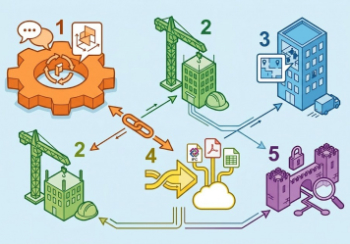
A user gives their low down.

A UK training and membership provider for mould remediation professionals.
Building Safety recap April, 2026
A short and longer run-through of the month, with links to further information and sources.

CIAT May 2026 briefing.

Independent NSI and BAFE study exploring how organisations are changing the way they buy fire safety services.

From medieval scribes to modern word art.

ECA welcomes crackdown on late payment and push for clean energy, whilst CIOB seek fixed cladding removal timeframes.
Cyber Security in the Built Environment
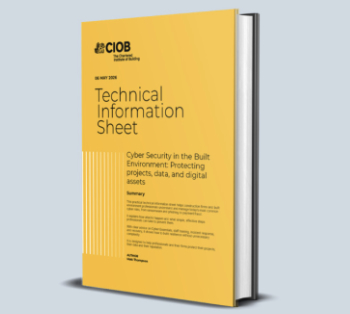
Protecting projects, data, and digital assets: A CIOB Academy TIS.
Managing competence in the built environment

ITFG publishes new industry guide on how to meet the ICC principles.
The UK's campaign to reduce noise pollution: Mythbusting, articles and topic guides.